


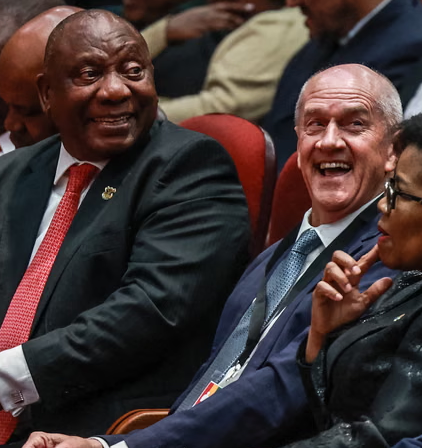
President Cyril Ramaphosa has signaled a dramatic shift in South Africa’s foreign policy by appointing veteran negotiator Roelf Meyer as the new Ambassador to the United States.
Replacing Ebrahim Rasool, whose tenure was marked by diplomatic friction that led to him being declared persona non grata in 2025, Meyer’s appointment is an urgent economic intervention designed to protect South African jobs and stabilize the South Africa cost of living in 2026. His primary mandate is now to mend those fractured ties to protect South African jobs and stabilize the South Africa cost of living in 2026, which has been under pressure due to the preceding year’s diplomatic isolation.
The decision by the host government to formally expel Rasool followed a series of controversial public statements and alleged interference in domestic policy. The “friction” wasn’t just a few bad meetings; it was a diplomatic breakdown of South Africa’s top representative by the world’s largest economy.
While his public criticism of the Trump administration was the immediate trigger, the groundwork for his expulsion was built on long-standing allegations regarding his ties to extremist groups and interactions with leaders of designated terrorist organizations like Hamas, Palestinian Islamic Jihad (PIJ) and Hezbollah.
How AGOA and US Trade Relations Affect South African Jobs
One of the main focuses of this new appointment is to protect the manufacturing sector and employment through AGOA.
For the residents of Gqeberha and East London, foreign policy is a matter of employment. The South African automotive industry is the backbone of the Eastern Cape economy, but its survival depends heavily on the African Growth and Opportunity Act (AGOA).
- The Data: In 2025, diplomatic tensions caused a catastrophic 75% drop in vehicle exports to the U.S. as uncertainty over South Africa’s trade status led American dealerships to look elsewhere.
- The Jobs: The sector supports over 110,000 direct jobs and nearly half a million indirect jobs. In a province with some of the highest unemployment rates in the country, the Meyer appointment is seen as the primary unemployment solution for South Africa’s manufacturing hub.
- The Goal: Meyer’s mandate is to secure a long-term extension of AGOA beyond the current December 2026 deadline, ensuring that brands like Mercedes-Benz, VW, and Isuzu keep their assembly lines running in South Africa.
If he fails, the assembly lines at Mercedes-Benz, Volkswagen, and Isuzu, which currently operate as “export-only” hubs for many models, could go silent. The ripple effect would be felt in every spaza shop and household in Gauteng and the Eastern Cape.
Why South Africa’s Citrus Exports Depend on US Relations?
While the Eastern Cape builds cars, Limpopo and the Sundays River Valley feed the world. South Africa is currently the world’s second-largest citrus exporter, forecasting a record 215 million cartons for the 2026 season.
However, a looming 30% U.S. tariff threat, a leftover from the diplomatic fallout of 2025, threatened to make South African oranges and lemons too expensive for American shelves. Meyer’s entry into Washington is strategically timed to negotiate a “Reciprocal Tariffs Agreement.” This would protect the livelihoods of thousands of seasonal farm workers and ensure that the agricultural sector remains a viable driver of the rural economy. This is also crucial because, in 2026, the agricultural sector is already reeling from a Foot-and-Mouth disease outbreak that has closed several Eastern markets. If the U.S. market closes as well, the rural economy faces severe economic pressure.
How Does Ramaphosa’s Foreign Policy Affect Food and Fuel Prices?
It might seem far-fetched, but a successful ambassador in Washington directly affects your grocery bill. When Ramaphosa secures stable trade routes, the Rand strengthens against the Dollar.
- Fuel Prices: A stronger Rand lowers the cost of importing crude oil, leading to lower prices at the petrol pump.
- Food Price Inflation: Since SA imports 50% of its wheat and significant amounts of poultry and electronics, a stable currency prevents “imported inflation,” keeping the price of bread, meat and basic goods from skyrocketing.
Export tariffs in Washington directly affect the cost of living in South Africa. It comes down to “Market Dumping.”
- Local Glut: If Meyer fails and the U.S. market closes, millions of cartons of export-grade fruit are forced back into the local South African market.
- The Downside: While this might make oranges cheaper for a few weeks, it causes local farm prices to collapse below the cost of production. Farmers then go out of business and stop planting, leading to massive rural unemployment and a long-term spike in food price inflation as local production capacity shrinks and we are forced to import staples at higher costs.
- Employment: Agriculture is the primary employer in rural SA. A stable foreign policy protects the wages of over 120,000 permanent workers and hundreds of thousands of seasonal pickers.
Why US-South Africa Relations Matter for Ordinary South Africans
The shift from the ideological approach of Ebrahim Rasool to the pragmatic, “bridge-building” style of Roelf Meyer proves that Ramaphosa’s foreign policy is increasingly focused on domestic survival. By prioritizing trade and security cooperation over rhetoric, the presidency is betting that a veteran negotiator can provide the stability needed to curb inflation and protect the South African workforce.
As we move further into 2026, the success of this diplomatic gamble will be measured by the stability of the Rand, the price of a loaf of bread, and the job security of the factory worker in the Eastern Cape.
President Ramaphosa has often said that “foreign policy is domestic policy.” By choosing his old negotiating partner, Roelf Meyer, he is signaling to the U.S. that South Africa is moving away from the strained relationship of the Rasool era. For the farmer in the Sundays River Valley or the picker in Limpopo, Meyer as ambassador becomes the shield protecting their livelihood from global trade wars.